Fire stopping in Slough
Gaps in walls and floors sealed with tested products. Every seal photographed and labelled.
Get a priceYou can have a wall rated for 60 minutes and still watch smoke go straight through it.
Usually it's down to one hole. A plumber runs a pipe through, an electrician pulls a cable in, and nobody puts the seal back.
Fire stopping closes that hole again, using a product that's been tested in a wall like yours. Then the wall can do the job it was built for.
Tell us what the building is and where the gaps are. If there's a survey report or a fire risk assessment, send that over too.
What we deal with
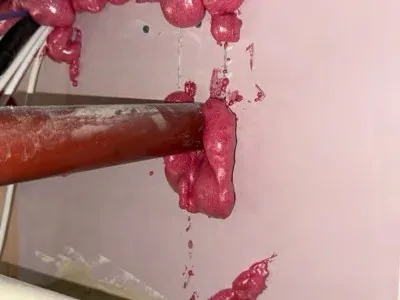
Pipes through walls and floors. Plastic ones get a collar or a wrap. Metal ones depend on what's in them and how they're lagged.
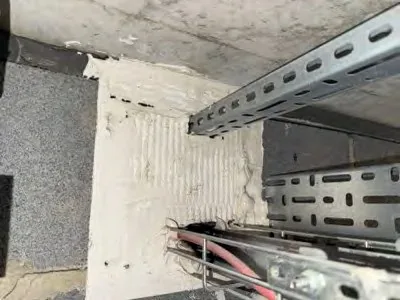
Cables. One cable and a full tray need different answers. Batts, pillows or coated board for the big openings, mastic for the small ones.
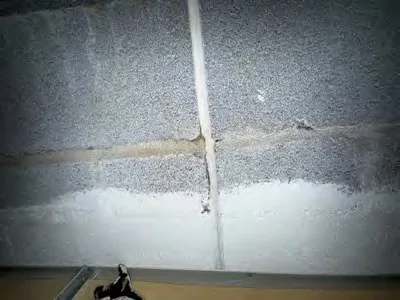
Joints. Where a block wall meets the slab above. The vertical joint between two walls. The gap along the top of a partition.
Voids. Ceiling spaces, risers and roof voids with no barrier in them, so a fire can travel the length of the building over everybody's head.
Old repairs. Mineral wool stuffed in a hole, standard expanding foam from a can, a scrap of plasterboard. It looks sealed. It isn't.
Who asks us to do this
Managing agents of blocks of flats, after a survey or an inspection by a fire risk assessor.
Hotel and care home operators who have had work done by several trades and want it checked.
Schools, which book it for the holidays.
Landlords and owners who have been given a letter by the fire service.
If you are not sure what you have, start with a compartmentation survey. It finds the gaps and gives you a list. The sealing is priced from that list.
How a job goes
We start from your report or from a visit.
You get a written scope. It says where each seal is and what goes in it.
The seals are done by our BM TRADA / FIRAS-certificated contractors. They fit products to the manufacturer's tested detail, so a collar goes on the pipe size it was tested for and the batts go in the wall type they were tested in.
At the end you get a record. Each seal has a number, a location, the product used and a photo. Your assessor can check it against the list.
A rough idea of cost
Fire stopping depends on how many seals there are and how hard they are to reach. A ceiling void with a hundred small cable gaps is a different job from ten large pipes.
As a rough guide, we price jobs from about £2,000 plus VAT. Smaller jobs than that do not make sense for a crew travelling from Luton. You get a written price before anything starts.
Questions we get asked
Do I need a survey before fire stopping?
Usually yes, if you do not already have a list. Without one nobody knows how many gaps there are.
Can you work while people live there?
Most of it, yes. Risers and voids can be done with the flats occupied. We arrange access with you in advance.
Is this the same as a fire risk assessment?
No. The assessor looks at the whole building. We seal the gaps the assessor or a survey has found.
What we seal
Send it over with the postcode. We will tell you what the work involves and roughly what it costs.
Get a price